Working Conditions
FRICTION
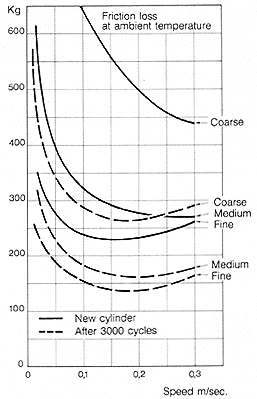
Friction is generated when an elastic material, such as a seal, slides against a metal surface in a normal sealing application. The theory for two rigid surfaces sliding against each other is relatively elementary compared with the more complex behavior of a flexible elastomer sliding against a rigid surface. The nature of the surfaces and the surface finish of the sliding parts are very important. A metal surface can have a certain degree of roughness that can significantly influence friction and wear. The friction loss when working at a constant speed is shown on the graph, which details three surface finishes when new and after 3000 cycles.
Another factor influencing friction is temperature. During temperature variations, the mechanical characteristics of the seal material and the viscosity of the fluid both change. As the temperature rises, the lubricant viscosity generally decreases, which can reduce the thickness of the lubricant film between the seal lip and the metal surface. However, the resulting effect on friction depends on the lubrication regime, seal material, surface roughness, sliding speed, and the temperature-dependent properties of the elastomer and lubricant.
Under conditions where the lubricant film becomes very thin, asperity contact between the seal lip and the metal surface may increase. Consequently, surface finish can have a significant influence on friction, wear, and sealing performance.
Figure F-1 illustrates two surface finishes in motion. The top section represents the rubber material, while the lower section represents the metal surface. Fa represents the resultant force associated with deformation and contact between the surfaces. Fd represents the force associated with the velocity-dependent and elastic characteristics of the elastomer. Between these two materials is the fluid lubricant, which influences both the deformation and friction characteristics of the seal interface.

Updated 9/28/2026